
182 N Port Road, Unit 3
Port Perry, Ontario L9L 0B7
Office: (905) 831-7001 / (888) 862-5356
Fax: (905) 831-7443 / (866) 885-1583
E-Mail: sales@lev-co.com
Ambient Air Cleaners
Products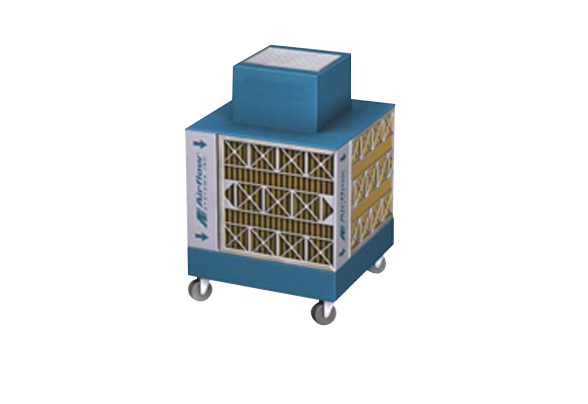
Ambient Air Cleaners are designed to help filter and recirculate contaminated air within industrial and commercial spaces. They are commonly used where fumes, smoke, dust, or other airborne particulates need to be reduced throughout a room or work area rather than captured only at a single point. These systems typically use washable, cleanable, or replaceable filter media and are often installed in overhead or room-level configurations to help clean the surrounding air.
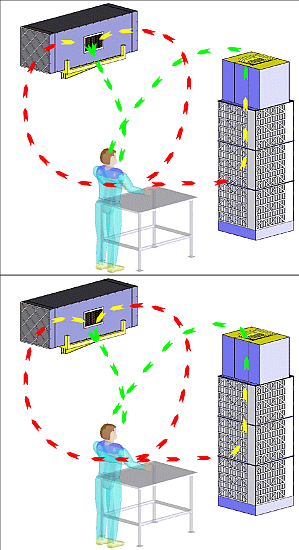
These systems are often used where broader air cleaning is needed across a shop, classroom, production area, or technical workspace. Depending on the layout and airflow pattern, Ambient Air Cleaners may be installed as free-hanging negative-pressure units, race-track systems, or cross-dilution arrangements to help scrub airborne contaminants from the space. They are generally best used as a supplement to source-capture equipment rather than as a replacement for it when contaminants can be captured directly at the source.
What are Ambient Air Cleaners?
Ambient Air Cleaners are room-level air-filtration systems that draw contaminated air through filter media and return cleaned air back into the workspace. Unlike source-capture systems that collect contaminants at the point of generation, these units are intended to reduce the general concentration of airborne contaminants that remain suspended in the space. They are commonly selected when a facility needs broader air cleaning across a room or wants to supplement existing local exhaust measures.
When should you use Ambient Air Cleaners?
Ambient Air Cleaners are typically used when airborne contaminants are dispersed through a room, when source capture alone does not address all residual airborne particulate, or when a facility wants to improve overall background air quality in a work area. They may be a strong choice for welding shops, educational shops, maintenance areas, repair environments, 3D printing spaces, and other operations where fine airborne contaminants can remain suspended beyond the immediate source. The best fit depends on room volume, desired air changes per hour, contaminant type, filter selection, mounting location, and the intended room airflow pattern.
Typical applications
- welding shops and fabrication areas
- educational auto, machine, and welding shops
- 3D printing environments
- repair and maintenance facilities
- buffing and polishing areas
- torch cutting support areas
- light manufacturing and assembly environments
- broader room-level air-cleaning applications
Key benefits
- helps reduce background airborne contamination across a room or work area
- supports cleaner indoor air where source capture alone may not address all suspended particulate
- available in multiple mounting and airflow configurations
- can be configured with washable, cleanable, or replaceable filter media
- suited to facilities looking for broader room-level air cleaning and recirculation
Important selection considerations
When selecting an Ambient Air Cleaner, key factors may include:
- room volume and ceiling height
- desired air changes per hour
- contaminant type and loading
- filter media type and maintenance method
- mounting location and airflow pattern
- whether negative pressure or directional airflow is needed
- integration with existing source-capture equipment
- maintenance access and long-term operating costs
The right Ambient Air Cleaner depends on how and where it will be used. LEV-CO can help review your room size, contaminant profile, airflow goals, and facility layout to recommend a practical solution for supplemental airborne particulate control and broader ambient air cleaning.
Ambient Air Cleaners involve the use of large “Washable, Cleanable or Replaceable Media” filters. These units both filter and re-circulate the air back into the work place.
Installation Configurations:
- Free Hanging “Negative Pressure”
- “Race Track”
- "Cross Dilution"
Depending upon the designed air pattern, these systems "scrub" the ambient air of contaminants, and the result is a dramatic reduction of airborne pollution. These systems are best used in combination with source-collection equipment.
- Aerospace - Deburring
- Aerospace - Steel Welding
- Apparel & Clothing - Clothing Assembly Line
- Apparel & Clothing - Textile Dyeing
- Auto body repair - Buffing and Polishing
- Auto body repair - Deburring
- Auto body repair - Steel Welding
- Auto body repair - Torch Cutting Ventilation
- Chemicals and Plastics - Pesticide Manufacturing
- Educational - Auto Shop
- Educational - Machine Shop
- Educational - Welding Shop
- Electronics - 3D Printing
- Farm & Heavy Equipment - Heavy Equipment Repair
- Farm & Heavy Equipment - Steel Welding
- Machine Shop - Steel Welding
- Metalworking - Steel Welding
- Misc. Operations - 3D Printing
- Misc. Operations - Cigarette and Tobacco Smoke
- MRO - Heavy Equipment Repair
- MRO - Steel Welding
- MRO - Torch Cutting Ventilation
- Municipal & DOT Garage - Steel Welding
- Museums & Artifacts - Paleontology
- National Defense - Indoor Pistol and Small Bore Rifle Range Ventilation
- National Defense - Steel Welding
- Robotics - 3D Printing
- Vehicle Repair - Buffing and Polishing
- Waste Management - Waste Management Facilities
- Welding Shops - Stainless Welding
- Welding Shops - Steel Welding
- Welding Shops - Torch Cutting Ventilation
Yes, but only when systems are configured, installed, and maintained for the correct use application. The filter selection is paramount to ensuring the reliability, effectiveness, and safety of the unit you use.
For a full list of industries, refer to our Industry Solution Page
For a list of available models, check out our catalog below.
Some important points to consider when purchasing:
- What is the volume of the room you want to clean?
- e.g. cubic dimension: L'xW'xH'
- How many times would you like to change the air in your room?
- e.g. Welding=8 AC/H
- How much contaminant do I generate?
- e.g. dust, smoke, fume
- Where am I going to mount these units?
- Can I use these units to create a negative pressure in my work area?
- Do I want "throw away", "washable", "cleanable" or "self cleaning" filters?
Industrial workers are exposed to a variety of health hazards every day. As a result, these workers risk the possibility of becoming sick, ill, and in some cases, permanently disabled. According to a WHO estimate (WHO, 2000), unintentional poisonings led to 300,000 deaths in the year 2000.
It's our mission to diminish that figure, but it only works if the correct equipment is used, and configured correctly. Our team works to make the logistics of those questions as straightforward and coherent as possible, and as such, will work with you to provide you with the best extraction system that fits your worker's needs. This includes everything from accessibility and usability to longevity and reliability.
You can read more about the risks and preventions of fume extraction below:
OSHA
WHO