182 N Port Road, Unit 3
Port Perry, Ontario L9L 0B7
Office: (905) 831-7001 / (888) 862-5356
Fax: (905) 831-7443 / (866) 885-1583
E-Mail: sales@lev-co.com
.png)
-1.JPG)
.JPG)
.JPG)
.JPG)
.JPG)
.JPG)
-1.JPG)
-1.JPG)
-1.JPG)
-1 (1) (1).jpg)
Dust Control Booths
Dust Control Booths are designed to help capture and contain airborne contaminants within a defined work area in industrial and commercial environments. They are commonly used where dust, fumes, smoke, vapours, or other process emissions need to be controlled while maintaining operator visibility and access to the work. These systems are often selected when keeping contaminants confined to the booth is an important part of the control strategy.
These systems are often used where the work process takes place in a dedicated booth, enclosure, or controlled work zone and where broader shop contamination needs to be limited. Depending on the application, Dust Control Booths may be used for deburring, welding, polishing, torch cutting, painting-related tasks, repair operations, laboratory work, and other processes where localized containment and filtration are important. The best fit depends on the contaminant, booth size, airflow through the work zone, filtration requirements, and the operating environment.
What are Dust Control Booths?
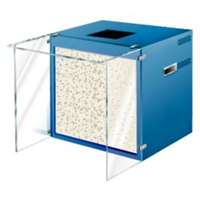
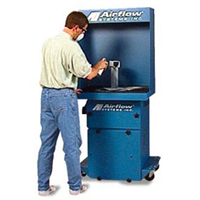
Dust Control Booths are enclosed or partially enclosed contaminant-control systems that allow operators to work on parts or components inside a defined capture area. Depending on the design, they may include booth walls or panels, integrated filtration, airflow management, lighting, and application-specific construction features. They are typically selected when a facility needs a more contained work area than an open capture hood or workstation system can provide.
When should you use Dust Control Booths?
Dust Control Booths are typically used when contaminants are generated during manual or semi-manual tasks and a dedicated booth can help keep those emissions contained within the work zone. They may be a strong choice for processes involving recurring dust, fume, smoke, or vapour generation, especially where worker visibility, accessibility, and contaminant confinement are all important. The best fit depends on required air speed through the booth, filter performance, booth dimensions, noise considerations, and whether additional risks such as fire or explosion need to be addressed.
Typical applications
- deburring and finishing
- welding and fabrication
- torch cutting
- buffing and polishing
- painting and small-part coating work
- laboratory and forensic work areas
- repair and maintenance operations
- educational and technical shop environments
Key benefits
- helps contain contaminants within a defined work area
- supports operator visibility and access during the process
- can reduce the spread of dust, fumes, or vapours into surrounding spaces
- available in different booth sizes and configurations
- can be matched to application-specific filtration and operating needs
Important selection considerations
When selecting a Dust Control Booth, key factors may include:
- contaminant type and concentration
- booth size and working envelope
- air speed through the work zone
- filtration efficiency and filter-cleaning effectiveness
- annual filter maintenance and replacement costs
- noise levels inside and outside the booth
- construction durability for the environment
- tertiary risks such as fire or explosion
The right Dust Control Booth depends on how and where it will be used. LEV-CO can help review your process, contaminant characteristics, work-zone requirements, and facility conditions to recommend a practical solution for enclosed contaminant control, filtration, and operator-focused booth design
Environmental Control Booths allow operators to work on a variety of components while assuring worker comfort and visibility within the critical area. These solutions also ensure that the "dust produced within the booth... stays in the booth..."
- Aerospace - Deburring
- Aerospace - Steel Welding
- Auto body repair - Buffing and Polishing
- Auto body repair - Deburring
- Auto body repair - Steel Welding
- Auto body repair - Torch Cutting Ventilation
- Chemicals and Plastics - Pesticide Manufacturing
- Educational - Auto Shop
- Educational - Machine Shop
- Educational - Welding Shop
- Farm & Heavy Equipment - Steel Welding
- Forensics - Forensic Laboratories
- Machine Shop - Steel Welding
- Metalworking - Steel Welding
- MRO - Steel Welding
- MRO - Torch Cutting Ventilation
- Municipal & DOT Garage - Steel Welding
- National Defense - Steel Welding
- Painting - Small Paint Booth
- Vehicle Repair - Buffing and Polishing
- Welding Shops - Stainless Welding
- Welding Shops - Steel Welding
- Welding Shops - Torch Cutting Ventilation
- Woodworking - Chainsaw
Yes, but only when the system is configured, installed, and maintained for the correct application. The filter selection is the most important decision for ensuring the reliability, effectiveness, and safety of the unit you select.
For a full list of industries, refer to our Industry Solution Page.
For a list of available models, check out our catalog below.
Some important points to consider when purchasing:
- Filter Cleaning: Is it easy to clean? Does the filter cleaning system really work?
- How large does the booth have to be?
- Is the air speed through the work zone high enough to protect the worker?
- What is the noise level? Inside and outside the booth?
- Will it stand up to your environment?
- e.g. is it made from plastic or steel?
- What will be my filter costs per year? - In welding you can use lbs. of welding wire…
- What is the filtration efficiency?
- Are there any tertiary risks such as fire, explosion, etc.?
Industrial workers are exposed to a variety of health hazards every day. As a result, these workers risk the possibility of becoming sick, ill, and in some cases, permanently disabled. According to a WHO estimate (WHO, 2000), unintentional poisonings led to 300,000 deaths in the year 2000.
It's our mission to diminish that figure, but it only works if the correct equipment is used, and configured accordingly. Our team works to make the process of answering those questions as straightforward and coherent as possible, and will work to provide you with the best extraction system that fits your worker's needs. This includes everything from accessibility and usability to longevity and reliability.
You can read more about the risks and preventions of fume extraction below:
OSHA
WHO